
The GDP growth is expected to be about 6.3 per cent in the current fiscal year, a tad lower than the government's estimate of 6.4 per cent, owing to several factors such as weak demand, SBI research report said on Wednesday. According to the first advance estimates (FAE) of National Income for 2024-25 released by the National Statistics Office (NSO), released on Tuesday, India's economic growth rate is estimated to slip to a four-year low of 6.4 per cent in 2024-25, because of poor showing by the manufacturing and subdued investments.

Bad loans in the peer-to-peer (P2P) lending industry more than doubled in financial year 2024 (FY24) to Rs 1,163 crore from Rs 472.1 crore in FY23, said a financial services company on Monday. Non-performing assets (NPAs), as such loans are officially called, were a modest Rs 14.7 crore at the end of FY19 when P2P lending was in its nascent stage, according to Capitalmind Financial Services that accessed data from the Reserve Bank of India (RBI) through a right to information application.

Automobile retail sales in India rose 6 per cent to 2,61,43,943 units in FY25 with rural areas performing better than urban regions across passenger vehicle and two-wheeler segments, dealers' body FADA said on Monday. The last financial year saw growth in sales of passenger vehicles, two-wheelers and three-wheelers.

"We will raise Rs 300 crore via bonds of two-, three- and five-year tenures. This will be our maiden bond issuance and is part of our effort to widen funding sources," says Vimal Bhandari, executive vice-chairman and chief executive officer (CEO), Arka Fincap. The firm, a subsidiary of Kirloskar Oil, is only five years old and small (assets of around Rs 5,000 crore with an "AA" rating), but the response to this float will be closely watched: It would be the first by a non-banking finance company (NBFC) after Mint Road upped the risk weights on bank exposures to them by 25 percentage points. The move by the Reserve Bank of India (RBI) has caught NBFCs off guard even though the issue had been flagged by Governor Shaktikanta Das with their corner-room occupants (and that of banks) in July and August 2023 - on consumer credit and the dependency on bank borrowings.

Ask rediffGURU and PF expert Nitin Narkhede your mutual fund and personal finance-related questions.

The decision by the Reserve Bank of India to introduce a unified regulatory framework on connected lending for all the regulated entities (RE) is expected to reduce the influence of business conglomerates in the Indian lending space, said bankers and experts. "Connected lending pertains to lending to related parties within the same business group. "While the RBI might appear more agreeable to allowing business conglomerates to own banking licenses, it deems it crucial to bolster regulations that would prevent conglomerate-owned banks from gaming the system," said Shivaji Thapliyal, head of research and lead analyst, YES Securities.

The Budget should undertake further reductions in import tariffs and seriously consider an announcement of India's intention to join one or both of the two Asian mega-regional free trade agreements, suggests Shankar Acharya, former chief economic adviser to the Government of India.

The RBI had earlier fixed September 30, 2023 as the last date for the purpose of completing the exercise in a time-bound manner and to provide adequate time to the public.

Debt mutual fund (MF) schemes are set to register the best calendar year (CY) performance in the last four years despite no changes in the interest rate. An analysis of one-year performance of debt funds show that many of the schemes are set to deliver double-digit returns in CY 2024.

The Reserve Bank of India on Friday raised the GDP growth projection for the current fiscal to 7 per cent from 6.5 per cent earlier on buoyant domestic demand and higher capacity utilisation in the manufacturing sector. Announcing the bi-monthly monetary policy, RBI Governor Shaktikanta Das, however, flagged protracted geopolitical turmoil and global economic fragmentation as risks to the growth outlook. The RBI kept interest rates unchanged at 6.5 per cent in Friday's monetary policy statement.
The Reserve Bank of India (RBI) has updated Know Your Customer (KYC) norms for politically exposed persons (PEPs) who transact with regulated entities (REs), seeking to comply with the recommendations of intergovernmental organisation Financial Action Task Force (FATF). PEPs are individuals entrusted with prominent public functions by a foreign country, including the heads of states/governments, senior politicians, senior government or judicial or military officers, senior executives of state-owned corporations and important political party officials, said the RBI. This change is expected to provide more clarity to undertake Customer Due Diligence (CDD), said the RBI in a communication to REs.

From the 30-share pack, Adani Port, Bharti Airtel, Asian Paints, IndusInd Bank, Bajaj Finserv, Reliance Industries, Infosys, UltraTech Cement, HDFC Bank, HCL Technologies and ICICI Bank were among the laggards. Tata Motors, Axis Bank, Maruti, Larsen & Toubro, ITC and Tata Steel were among the gainers.

The RBI is fully aware that the high-cost loans and high indebtedness of the borrowers could pose financial stability risks, if not addressed by these NBFCs. Governor Shaktikanta Das has issued a stern warning, saying the RBI is closely monitoring these areas and will not hesitate to take appropriate action, if necessary, if the culprits don't opt for self-correction. Watch out for some action, soon, notes Tamal Bandyopadhyay.

Ramalingam Kalirajan offers some easy steps to reactivate your accounts with banks like SBI, HDFC Bank, IDFC First Bank and PNB just so that you can start availing all the benefits linked to your account.

S&P Global Ratings on Tuesday cut India's GDP growth projections to 6.5 per cent for the next fiscal as it expects that economies in the APAC region will feel the strain of rising US tariffs and pushback on globalisation. In its Economic Outlook for Asia-Pacific (APAC), S&P said despite these external strains, it expects domestic demand momentum to remain solid in most emerging-market economies.

Striking a different note from its peers, US brokerage Bank of America Securities has maintained that the Reserve Bank will leave rates unchanged next week, recognising growth-focused and capex-driven fiscal expansion, which though poses huge price pressure and interest rate risks later. The RBI's rate setting panel Monetary Policy Committee (MPC) will begin its deliberations next Monday and announce the policy moves on Wednesday (February 9) in the backdrop of a massive spike in bond yields post the Budget. Almost all major central banks are in the process of hiking rates to tame inflation.
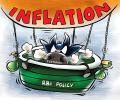
The Reserve Bank of India on Friday retained its projection for retail inflation at 4.5 per cent for the current fiscal assuming a normal monsoon, while emphasising that uncertainties related to food price outlook warrant a close monitoring. Consumer Price Index (CPI)-based retail inflation has been projected at 4.5 per cent with quarter-wise projections at 4.9 per cent in Q1 (April-June), 3.8 per cent in Q2, 4.6 per cent in Q3, and 4.5 per cent in Q4.

A strong demand was made in the Lok Sabha to eliminate online betting and gambling applications. YSRCP member Maddila Gurumoorthy urged the government to set up a dedicated task force to take action against betting and gambling apps. He also asked the government to draft regulations for such applications and launch awareness campaigns about the dangers of online betting. Other issues raised included deposit insurance coverage for bank depositors, representation of Scheduled Castes in the Kerala government, challenges faced by nurses, and the need for paramilitary forces in Jharkhand during upcoming Hindu festivals.

The liquidity will move into deficit after advance tax payments and GST outflows. It will rebound in October because of government spending.

The Reserve Bank of India (RBI) on Monday said 98.04 per cent of the Rs 2000 banknotes have been returned to the banking system, and only Rs 6,970 crore worth such notes are still with the public. On May 19, 2023, the RBI announced the withdrawal of Rs 2000 denomination banknotes from circulation.

The Reserve Bank of India (RBI) on Friday said nearly 97.26 per cent of the Rs 2,000 bank notes have been returned to the banking system, and only about Rs 9,760 crore worth of the notes are still with the public. On May 19, the RBI announced the withdrawal of Rs 2,000 denomination bank notes from circulation. "The total value of Rs 2,000 bank notes in circulation, which amounted to Rs 3.56 lakh crore as at the close of business on May 19, 2023 when the withdrawal of Rs 2,000 bank notes was announced, has declined to Rs 9,760 crore as at the close of business on November 30, 2023," the RBI said in a statement.

India Ratings on Thursday said that any broad-based or strong recovery in corporate capital expenditure was unlikely in the upcoming financial year 2026 (FY26) due to uncertainty of domestic and external demand. The uncertainty is adversely affecting the overall corporate sector capex. Interest rates on credit are not the primary deterrent to decisions about capital expenditure, said Soumyajit Niyogi, director, core analytical group, Ind-Ra, in a webinar on the credit market outlook.

The liquidity deficit in the banking system crossed Rs 2 trillion again on Monday, despite the second instalment of cash reserve ratio (CRR) reduction coming into effect from December 28.

Credit card spending reached Rs 2 trillion in October, a 14.5 per cent rise from September, largely driven by festival season purchases. However, the volume of outstanding credit cards increased only marginally during the same period. The spike in spending comes at a time when nearly all major credit card issuers are calibrating their growth in the segment due to visible signs of stress.

India will be the world's third-largest economy by 2028 as it becomes the world's most sought-after consumer market and gains share in global output, driven by macro stability influenced policy and better infrastructure, Morgan Stanley said. From a $3.5 trillion economy in 2023, the Indian economy is projected to expand to $4.7 trillion in 2026, which will make it the fourth largest in the world behind the US, China and Germany.

When investing in fixed-income products, balancing considerations like safety, liquidity, and income is essential.

India's foreign exchange reserves fell for the fourth consecutive week after reaching an all-time high last month. In the week ending October 25, the forex reserves declined by $3.46 billion to $684.80 billion, according to data released by the Reserve Bank of India (RBI) on Friday. In the three preceding weeks, reserves dropped by $3.7 billion, $10.7 billion, and $2.16 billion, respectively, the data showed.

In a move to strengthen governance in private sector banks and wholly-owned subsidiaries of foreign banks, the Reserve Bank of India (RBI) on Wednesday directed them to have at least two wholetime directors. Lenders that do not meet the requirement will have to submit the names for the RBI's approval within four months. Banks need prior approval from the banking regulator for the appointment of wholetime directors.

The RBI's decision to tighten norms for unsecured personal loans is credit positive because lenders will need to allocate higher capital for such loans, thus improving their loss-absorbing buffers, Moody's Investors Service said on Monday. The Reserve Bank last week raised risk weights on unsecured retail loans, credit cards and lending to non-banking finance companies (NBFCs) by 25 percentage points. Moody's said unsecured loans have been growing rapidly in the past few years, exposing financial institutions to a potential spike in credit costs in case of sudden economic or interest rate shocks.
The Reserve Bank of India on Thursday projected a GDP growth of 7 per cent for 2024-25 financial year, which is lower than the 7.3 per cent expansion estimated for the current fiscal. Announcing the bi-monthly monetary policy, RBI Governor Shaktikanta Das said rural demand continues to gather pace, urban consumption remains strong and investment cycle is gaining steam on the back of increased capex.

Net NPAs increased to Rs 36,260 crore in the December quarter from Rs 34,843 crore in September and Rs 33,116 crore in December 2023, observes Tamal Bandyopadhyay.

On the back of sound macroeconomic policies and softer commodity prices, India's growth momentum is likely to be sustained in 2023-24 in an atmosphere of easing inflationary pressures, said the Reserve Bank's annual report released on Tuesday. It, however, added that slowing global growth, protracted geopolitical tensions and a possible upsurge in financial market volatility following new stress events in the global financial system could pose downside risks to growth. "On the back of sound macroeconomic policies, softer commodity prices, a robust financial sector, a healthy corporate sector, continued fiscal policy thrust on quality of government expenditure, and new growth opportunities stemming from global realignment of supply chains, India's growth momentum is likely to be sustained in 2023-24 in an atmosphere of easing inflationary pressures," it said.
